History
History of the mas and oratory
History
The history of the mas and oratory
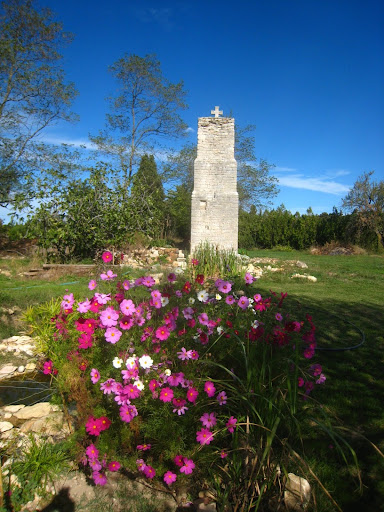
At the time of the Roman settlement in Gaul, a Roman villa was built on the estate’s site. At the same period, to the east of the property, a Roman monument was erected near the ancient road so as to be visible to all. This Gallo-Roman vestige, now listed as a Historic Monument, is a funerary pillar built by a wealthy landowner during his lifetime, symbolizing prestige and power in the Roman era.
Standing approximately 4 meters high and composed of three levels, this Gallo-Roman funerary pillar, typical of ancient architecture, is regarded by archaeologists as one of the best-preserved examples in the entire south of France. This historic monument in Provence offers a remarkable testament to Roman heritage, providing visitors with a unique immersion into the region’s ancient history.

History
Oratory
In 1747, a religious oratory was built and attached to the northern side of a Roman monument to house a statue of the Virgin Mary.
This historic place of devotion, a testament to Provence’s religious heritage, illustrates the site’s spiritual continuity through the centuries.
An Occitan cross was placed at its summit, a powerful symbol of Occitan cultural identity and the estate’s deep regional roots.
This ancient oratory, rich in history and emotion, naturally gave its name to the present-day Provençal mas, further enhancing the soul and authenticity of this character-filled estate in Provence.
Mas
The foundations
In 1783, a large wine-growing farmhouse was built on the foundations of a former Roman villa that had since disappeared. Over time, it evolved into the Provençal mas we know today. This historic estate in Provence bears witness to centuries of occupation and agricultural development.
From 1920 onward—and likely earlier—the farm was divided into two separate properties. The section that now corresponds to the main guesthouse (excluding the kitchen) served at the time as the working farmhouse, while the other buildings were used as agricultural barns by a second owner. A dividing wall split the courtyard, clearly delineating the two spaces.
In 2005, the owner at the time acquired the abandoned former barns, making it possible to restore the original scale and unity of the farm, thereby fully reviving the grandeur of this character-filled Provençal mas.
.
Historical discoveries
The land surrounding the mas reveals numerous archaeological remains, including fragments of pottery dating back to the 1st century BC and Roman roof tiles, attesting to the site’s importance during the Gallo-Roman period.
In 1823, archaeological excavations carried out on the land known at the time as “Ferme Saussines” led to the exceptional discovery of a Roman dolium. This monumental terracotta jar, remarkably well preserved, measured 3.10 meters in height, with a maximum circumference of 4.35 meters, a base diameter of 2.35 meters, and a capacity of 1,800 liters. It was used for storing wine, oil, or grain, bearing witness to the site’s ancient agricultural activity.
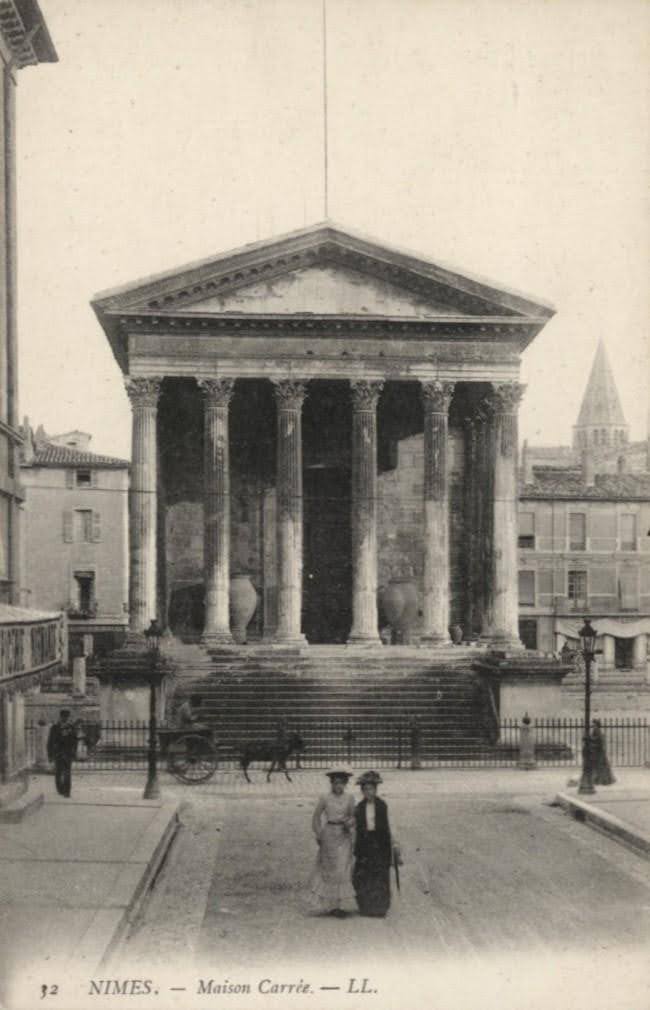
This Gallo-Roman dolium was displayed for many years in front of the Maison Carrée in Nîmes, alongside a second dolium with a capacity of 1,400 liters, until the 1980s, when both were unfortunately damaged by acts of vandalism. The 1,400-liter dolium, now restored, can be seen today at the Musée de la Romanité in Nîmes, preserving the memory of this exceptional ancient heritage from southern France.